
67 years of Kamal Haasan in Cinema: The man who refused to stop discovering film – F’day Spl. Article by Naveen

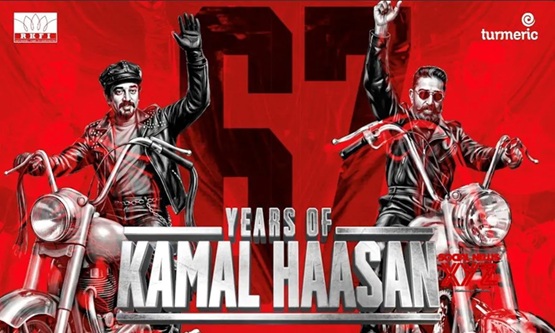

There are actors who become stars. There are stars who become icons. And then there are a rare few who become inseparable from the very idea of cinema. Kamal Haasan belongs to that last category.
As he completes 67 years in Indian cinema, it is difficult to describe his journey merely as a career. It is a continuing conversation between an artist and an art form — one that began when he was a child and has never really stopped. He entered cinema through ‘Kalathur Kannamma’ as a child artiste and went on to build a body of work that has crossed languages, genres, generations and conventional definitions of stardom.
What makes the milestone remarkable is not simply its duration. It is the restless curiosity that has accompanied it. Kamal Haasan has never appeared satisfied with being merely an actor.
He has been an actor, filmmaker, writer, producer, lyricist, playback singer and choreographer. His career has repeatedly demonstrated that his fascination with cinema extends far beyond the performance in front of the camera. FICCI, while honouring his contribution to Indian cinema, described his work across several of these disciplines as part of an extraordinary body of work.
The child who received the President’s Gold Medal for his performance in ‘Kalathur Kannamma’ grew into an actor who seemed determined to test the limits of what a leading man could be. That transformation is perhaps the most fascinating part of his story.
Kamal did not simply inherit the traditional image of a Tamil film hero and preserve it. He constantly dismantled and rebuilt it. He could be vulnerable, eccentric, romantic, tragic, comic, physically transformed or morally complicated. He could carry a mainstream entertainer one year and disappear into an uncomfortable, deeply human character the next.
That willingness to take risks became one of his defining qualities. The 1970s brought a series of collaborations and performances that established him as an actor with ambitions beyond conventional heroism. His association with filmmakers such as K Balachander played a crucial role in shaping that identity. Films such as ‘Apoorva Raagangal’, ‘Avargal’ and ‘Moondram Pirai’ demonstrated different facets of an actor increasingly willing to place character before image.
And then came the 1980s, a period in which Kamal’s artistic identity became even more distinctive. ‘Nayakan’ remains perhaps the clearest example of how performance, writing, visual storytelling and character construction could converge in a single film. His portrayal of Velu Nayakar transformed a gangster story into an intimate study of power, family, memory and morality. The film’s enduring reputation is reflected in its inclusion in Time magazine’s list of the 100 greatest films.
But to reduce Kamal’s contribution to a handful of celebrated performances would be to miss the larger story. He has repeatedly used popular cinema as a laboratory.
‘Pushpak’ demonstrated how much could be communicated without conventional dialogue. ‘Sathyaa’ brought a different kind of social anger into the mainstream. ‘Apoorva Sagodharargal’ showed his appetite for transformation and technical experimentation. ‘Michael Madana Kama Rajan’ revealed his extraordinary comic timing and willingness to inhabit multiple characters. ‘Thevar Magan’ explored questions of tradition, violence and inheritance. ‘Indian’ turned an ageing freedom fighter into an unlikely action protagonist while placing corruption at the centre of its narrative.
And then there were the films that seemed to arrive before their time. ‘Hey Ram’, ‘Virumaandi’ and ‘Vishwaroopam’ were not merely vehicles for a star. They were projects shaped by an artist attempting to control the grammar of filmmaking itself.
This is where Kamal Haasan’s legacy becomes particularly important to South Indian cinema. His greatest contribution may not be any single performance. It may be the permission he gave an entire generation of filmmakers and actors to experiment.
He made it possible to believe that a commercial hero could also be deeply interested in technique. That a star could write. That an actor could direct. That songs, makeup, choreography, editing, sound and visual effects could all be treated as creative languages rather than merely production departments.
His career also helped make the idea of the pan-Indian actor feel natural long before the phrase became an industry marketing strategy. He has worked extensively across Tamil, Telugu, Malayalam, Kannada, Hindi and other Indian-language cinema, building audiences beyond the boundaries of his home industry.
Yet perhaps the most enduring aspect of Kamal’s career is his relationship with failure. Not every experiment worked. Some ambitious films divided audiences. Some ideas arrived before the technology or commercial ecosystem was ready for them. Some performances were appreciated more strongly with the passage of time than they were upon release. But Kamal continued. That is an important distinction.
For an actor at his level, the safest path would have been to repeat what worked. Kamal repeatedly chose the opposite route. Even after achieving extraordinary stardom, he continued to pursue unfamiliar characters, new filmmaking techniques and stories that did not always conform to the expectations attached to a superstar.
His later career has only reinforced that quality. ‘Vikram’ demonstrated that age had done little to diminish his understanding of mass cinema. The film connected with a new generation while drawing upon the mythology of his earlier work. ‘Kalki 2898 AD’ placed him within an expansive science-fiction universe, once again showing his willingness to enter new cinematic spaces. Recent decades have therefore not represented a retreat into nostalgia but another phase of experimentation.
That may ultimately be Kamal Haasan’s greatest achievement. He has refused to become a museum piece. At a time when many stars eventually become custodians of their own past, Kamal has continued to look forward. He remains interested in what cinema can become rather than merely celebrating what it has already been.
For audiences in Tamil Nadu and across South India, his 67-year journey is therefore more than a celebration of longevity. It is a celebration of possibility.
Generations of viewers have grown up watching Kamal Haasan change shape — sometimes physically, often emotionally, and almost always artistically. Parents introduced his films to their children. Young actors studied his performances. Filmmakers borrowed from his experiments. Writers found confidence in his willingness to tackle uncomfortable subjects. Technicians benefited from his curiosity about the craft behind the camera.
And audiences kept watching. That relationship between artist and audience has survived changing tastes, changing technologies and changing definitions of stardom.
Kamal Haasan began his journey at a time when Indian cinema was still largely built around the conventions of the studio era. He has lived through the rise of television, video, satellite broadcasting, multiplexes, digital filmmaking, streaming and the modern pan-Indian film industry.
He did not merely survive those transformations. He participated in them. That is why 67 years is not just a number when it comes to Kamal Haasan. It is a measure of endurance, certainly. But more importantly, it is a measure of reinvention.
The boy who entered a film set in the late 1950s could have grown into a successful actor and stopped there. Instead, he kept asking questions. How can an actor disappear into a character? How far can a mainstream film go? Can a star produce a story that challenges his own image? Can technology expand storytelling? Can cinema entertain without surrendering intelligence? Those questions have followed him through seven decades.
And perhaps that is the fitting tribute to Kamal Haasan: not to call him the greatest simply because he has lasted the longest, but to recognise that he has spent 67 years refusing to let cinema become routine.
For an artist, longevity is impressive. But curiosity sustained across 67 years is something else entirely. Kamal Haasan’s greatest performance, in many ways, has been the role he has played throughout his life — that of a student who never stopped learning his craft. And Indian cinema is richer because he never did.
