

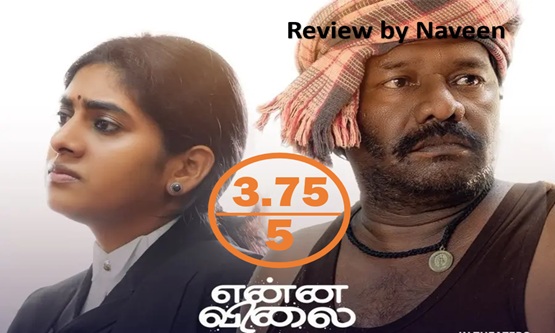

A timely question with great performances
“Enna Vilai”
– Review
The idea of luxury is inseparable from the idea of necessity. What one person considers essential can easily become a privilege for another in a society shaped by class, caste and economic inequalities. Sajeev Pazhoor’s ‘Enna Vilai’ attempts to examine this imbalance through the story of an ordinary family caught in an extraordinary legal and social crisis. The film raises several relevant questions about justice, institutional power and the value of truth, even if it doesn’t always find the most effective cinematic way to address them.
Thavasi Muthu (Karunaas) lives in Rameshwaram with his wife Palamma (Vijayalakshmi Veeramani) and their children. He earns his living through various small jobs, including diving into the sea to retrieve coins tossed by pilgrims visiting the temple town. Palamma too takes up odd jobs around the temple. Despite their modest circumstances, the couple are determined to provide their children with a good education.
Thavasi is portrayed as a straightforward, hardworking man who treats people with dignity irrespective of their social standing. His simplicity, however, becomes a vulnerability when he unexpectedly finds a gold locket during one of his dives. What initially appears to be an innocent discovery soon pulls him into a complicated chain of events involving the police, the law and the machinery of the state.
Sajeev Pazhoor, who was one of the writers of the National Award-winning Malayalam film ‘Thondimuthalum Driksakshiyum’, once again builds his story around gold, theft and police intervention. There is also a familiar idea at its centre: the process of seeking justice can itself become a form of punishment.
But ‘Enna Vilai’ deliberately expands its canvas beyond the immediate story. Rather than remaining solely with Thavasi and his family, the film moves into questions about the media, public opinion, social media outrage, bureaucracy and the functioning of the judicial system. This broader ambition gives the film plenty to discuss, but it also causes the narrative to lose focus.
The problem isn’t that the legal aspects are difficult to understand. Instead, the film occasionally struggles to establish a clear dramatic direction. Several developments feel as though they exist primarily to communicate an idea rather than deepen the characters or advance the emotional narrative.
The treatment of the media is another example. Turning television channels and sensational coverage into an antagonistic force is hardly unfamiliar territory, and the film’s depiction of this conflict sometimes feels generic. The same applies to its handling of online outrage and the mobilisation of public sentiment.
Yet there are moments when ‘Enna Vilai’ becomes genuinely powerful. One particularly effective sequence involves Thavasi and his family being surrounded by the media. Already terrified by the possibility of going back to prison, Thavasi must also protect his family from cameras invading their personal space. When Palamma turns towards the assembled cameras and responds with a piercing stare, the scene becomes a sharp observation of media voyeurism and the audience’s appetite for spectacle. It is precisely this kind of understated moment that the film could have used more often.
Karunaas is convincing as Thavasi, bringing an unaffected quality to a character whose world gradually collapses around him. Vijayalakshmi Veeramani is equally effective as Palamma, particularly when the character’s quiet strength comes to the forefront. Nimisha Sajayan plays Kanchana, Thavasi’s lawyer, but the courtroom portions don’t always have the dramatic energy the story demands. Lawyers cite sections, objections are raised and formal exchanges take place, but the proceedings occasionally feel more functional than compelling.
There is, however, a lovely little detail in one courtroom sequence. When a power cut leaves the judge uncomfortable, an assistant brings in a battery-operated fan. Once electricity returns, the judge asks him to leave the fan there. It is a small moment, but it adds a touch of personality to a setting otherwise dominated by procedural exchanges.
The film could also have spent more time exploring Thavasi’s family. His son’s emotional response, as well as the relationship between his daughter and her lover, are given limited space. As a result, the audience doesn’t always get the emotional foundation necessary to fully connect with the family’s larger struggle.
Sam CS’s music complements the film’s Rameshwaram setting. The background score, at times resembling droplets striking water, is an interesting choice that connects with the film’s recurring association with the sea. However, the score occasionally becomes too prominent and competes with the imagery instead of enhancing it.
The title question eventually becomes the film’s central philosophical concern: what is the value of something? Truth? Dignity? Justice? A person’s reputation? In an age where public perception can change within minutes and artificial intelligence is making the distinction between fact and fabrication increasingly complicated, these are questions worth asking.
‘Enna Vilai’ argues for a system that treats individuals equally and preserves their dignity. Its answers are perhaps too straightforward for the complexity of the issues it raises, and the film can become verbose while making its point. Still, its central question remains relevant long after the proceedings end.
On the whole, ‘Enna Vilai’ is a well-intentioned social drama with strong performances and some striking moments.
Rating: 3.75 out of 5
