


Toast with heist
‘Sigma’
Movie Review
There is an inherent appeal to a good heist film. The pleasure comes not merely from the money at stake, but from watching a clever plan take shape, seeing unexpected obstacles emerge, and wondering how the characters will pull off the impossible. ‘Sigma’, directed by Jason Sanjay in his debut, has all the ingredients for such a film — a huge stash of cash, dangerous criminals, multiple keys, a motley group of characters and elaborate action set pieces.
Sundeep Kishan plays Guru, a man who operates a library from his ancestral house while struggling under a mountain of debt. His circumstances change when he becomes connected to a much bigger criminal operation involving a vault containing Rs 1,000 crore.
The money belongs to Veerayya Reddy (Sampath Raj), a smuggler and poacher who has gone to considerable lengths to protect his fortune. Access to the vault depends on two keys. One is in Veerayya’s possession, while the other belongs to Ezhil (Kiran), a drug dealer. Adding another layer to the story is Vincent (Shiv Panditt), who runs a casino disguised as a theatre and uses the establishment as a base for Ezhil’s activities.
There are several other characters and subplots — including an assassin, a romantic track and a woman seeking revenge — that eventually intersect with Guru’s story.
On paper, there is enough material here for an entertaining commercial thriller. The problem is that the screenplay rarely turns these ingredients into genuine excitement.
For a debut filmmaker, attempting a large-scale genre film is an ambitious choice. But ‘Sigma’ frequently feels as though it is borrowing from familiar heist and action templates rather than developing a distinct identity of its own. The film introduces character after character, but many of them struggle to leave an impression. Even the central conflict takes considerable time to acquire urgency.
The villains, despite their criminal backgrounds, rarely generate much menace, while Guru is not given enough material early on to establish himself as the kind of protagonist audiences would want to follow. The supporting characters fare no better, with several of their scenes depending heavily on broad humour and awkward dialogue.
The writing is particularly inconsistent. Some of the attempts at humour and wordplay feel forced rather than organic, while conversations that should build character or tension often end up slowing the film down.
The biggest issue, however, is the treatment of the central heist. For a film built around a vault containing an enormous amount of money, there is surprisingly little emphasis on the mechanics of stealing it. The audience is repeatedly reminded of the prize, but the protagonists spend relatively little time devising an intelligent strategy to get their hands on it.
When the actual planning begins, the screenplay does not provide enough cleverness or detail to make the operation convincing. A heist thriller requires the audience to buy into the plan before it can enjoy watching that plan fall apart or succeed. Here, the film often skips that crucial step.
There are flashes of potential in the action design. A sequence inside an automated parking facility, for instance, could have been a standout moment. The setting offers plenty of opportunities for inventive choreography and visual tension. Yet the scene struggles to sustain momentum, with Guru’s entry coming after much of the action has already unfolded.
Another fight set inside a tempo van also illustrates the writing problems. The cramped location could have produced a tightly choreographed sequence, but basic spatial logic is not always convincing.
These moments are symptomatic of a larger problem: the film occasionally finds an interesting setting or idea but does not develop it enough to extract its full potential.
The technical scale is more evident than the narrative ambition. The film has been mounted on a sizeable canvas, and the production design, locations and aerial photography give it a certain visual polish. Yet scale alone cannot create suspense. A lavishly mounted sequence still needs strong staging, rhythm and narrative purpose.
The editing further works against the film. The frequent cuts and abrupt transitions give portions of ‘Sigma’ an episodic quality, making the narrative feel less cohesive than it should. Instead of building momentum towards the central operation, the film keeps diverting attention towards its numerous subplots.
The performances are similarly uneven. Sundeep Kishan brings energy to Guru but is limited by a character who is not consistently well-defined. Sampath Raj and Shiv Panditt have roles that could have been more intimidating, but the writing rarely gives them enough material to establish a strong screen presence. The supporting cast is also let down by dialogue that often feels unnatural.
There is also an awkward disconnect in the film’s handling of its supposed progressive messaging. An item number involving Catherine Tresa reportedly positions itself against the objectification of women, while its presentation sends a rather different visual message. The contradiction is difficult to overlook.
Ultimately, ‘Sigma’ feels like a film caught between ambition and execution. Jason Sanjay clearly wants to deliver a big, contemporary commercial entertainer, and there are moments where the scale and choice of genre suggest the possibility of something engaging.
But a heist film lives or dies by its writing. The audience needs to understand the stakes, believe in the strategy and feel the tension when the plan begins to unravel. ‘Sigma’ spends considerable time setting up its criminal world. As a debut, it is an ambitious attempt.
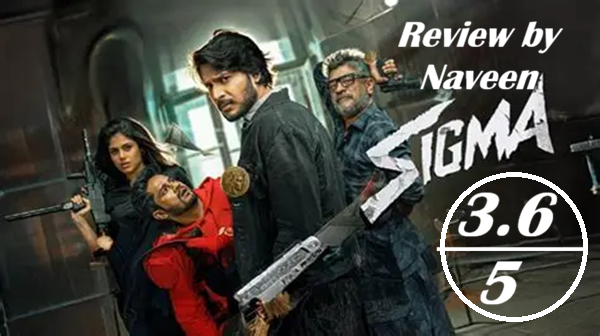
Rating: 3.6 out of 5
By Naveen
***
