


Political satire on rural displacement
“Kenatha Kaanom”
– Review
In a drought-affected village, the local residents, led by a community elder (Yogi Babu), initiate the digging of a communal well to address their water crisis.
The project takes an unexpected turn when the excavation reveals significant prehistoric fossils.
This discovery triggers a massive influx of government agencies, including archaeologists and security forces, who quickly cordon off the area.
The narrative follows the villagers as they navigate the loss of their land and the suspension of their daily lives in the face of a high-profile scientific investigation.
Director Suresh Sangaiah maintains his signature observational style, focusing on the systemic absurdity that arises when “experts” clash with locals.
The execution is deliberate, favoring long scenes that capture the confusion of the villagers as they are sidelined by official procedures.
While the film’s central conceit involves an extraordinary discovery, Sangaiah keeps the tone grounded, treating the arrival of the government as a cold, administrative process rather than a thriller.
The pacing is steady, though the second half focuses heavily on the standoff between the law and the residents, which may feel repetitive to some viewers.
Performances
Providing a steady presence, Yogi Babu delivers a performance characterised by restraint. He portrays the priest not as a comic figure, but as a pragmatic leader attempting to mediate between his people and the authorities.
George Maryan represents the bewildered voice of the older generation, effectively conveying the frustration of a man who finds his traditional way of life suddenly deemed an “archaeological site.”
Ramakrishnan, Raichal Rabecca, and Lovelyn Chandrasekhar function as a cohesive ensemble. Their performances are naturalistic, contributing to the film’s depiction of a community facing collective uncertainty.
Mottai Rajendran also appears in a role that leans more toward grounded character work than his usual caricature style.
Music composer Nivas K. Prasanna’s score is minimalist, often utilizing silence or ambient rural sounds to emphasize the isolation of the village. The music serves to underscore the tension without dictating the audience’s emotional response.
Cinematographer V Thiyagarajan uses a realistic, desaturated palette that highlights the dry, sun-baked terrain.
The visual contrast between the simple village structures and the sterile, metallic equipment of the government teams is clearly established.
Editor R. Ramar keeps the film to a concise 116 minutes, ensuring that the bureaucratic deadlock remains the central focus without the narrative drifting into unnecessary subplots.
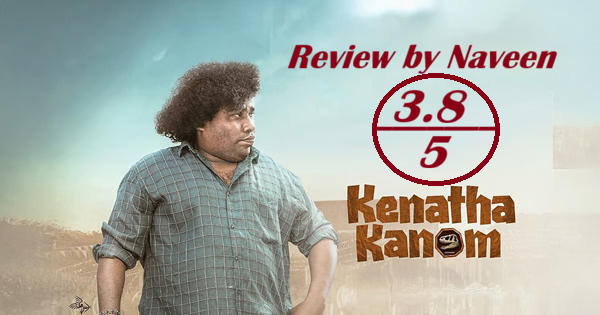
Rating: 3.8/5
By Naveen
***
