


A fiercely raw film caught between its politics and its gaze
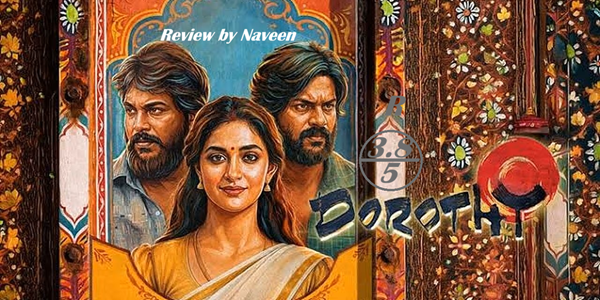
‘Dorothy’
– Review
There is very little polish in ‘Dorothy’, and that appears to be precisely the point. Karthik Subbaraj’s latest film feels earthy, uncomfortable and deliberately unvarnished, transporting us to a rural Tamil Nadu of the 1990s where caste, class, patriarchy and violence are woven into everyday life. Even its most beautiful elements seem to carry a certain roughness. Ilaiyaraaja’s music, for instance, does not simply decorate the film; it deepens the atmosphere and occasionally makes its most disturbing moments even more unsettling.
At the centre of this world are Karthi (Rishikanth) and Subbu (Sananth), childhood friends who have grown into men shaped by the same rigid ideas of masculinity that surrounded them. Their version of friendship is built around drinking, fighting, food, crude entertainment and long stretches of doing nothing. They are not necessarily villains; they are products of their environment, faithfully reproducing the behaviour they have seen all their lives.
That equation changes when Dorothy (Keerthy Suresh), a Malayali woman, enters Subbu’s family as his sister-in-law. Her presence gradually exposes cracks in the relationship between the two friends and, more importantly, begins to unsettle the social conditioning that has governed their lives.
Subbaraj has frequently used genre cinema to smuggle in larger social and political ideas, but ‘Dorothy’ is considerably more direct. Caste hierarchy, patriarchy, gender expectations, violence and the politics surrounding marginalised identities are not peripheral concerns here. They are the film’s foundation. The director’s personal investment in these subjects is evident in both the writing and the visual construction. Yet this is also where the film becomes deeply conflicted.
‘Dorothy’ wants to question oppressive social structures, but it repeatedly spends considerable time depicting the very brutality it eventually seeks to condemn. Violence against women and a trans character is presented with an intensity that can become difficult to reconcile with the film’s stated politics. The intention may be to expose the ugliness of such behaviour, but the prolonged nature of some of these sequences risks turning observation into exploitation.
The film’s handling of its trans character is particularly complicated. ‘Dorothy’ clearly wants to argue for dignity, acceptance and inclusion, but it initially surrounds the character with several familiar stereotypes and traumatic experiences. The eventual emotional payoff does not completely erase the discomfort created by what precedes it. The film therefore finds itself in an unusual position: attempting to challenge prejudice while occasionally reproducing some of the imagery associated with that prejudice.
Its treatment of caste is similarly observational rather than consistently confrontational. The film is acutely aware of how caste operates in its world, but much of its attention goes towards portraying the attitudes and behaviour of casteist characters rather than dismantling those ideas through the narrative itself.
Still, there are moments when Subbaraj’s writing finds a much subtler and more effective way to make its point. The evolving relationship between Karthi and Subbu is the film’s most interesting device. Subbu, who once taught Karthi his ideas of what it means to be a ‘man’, eventually becomes part of Karthi’s journey towards understanding a far broader idea of femininity and human vulnerability.
It is a quietly effective reversal, and one that gives the friendship an emotional dimension beyond the film’s social commentary. There is also something intriguing about the names Karthi and Subbu, which together echo the director’s own name, suggesting that this may be his most personal work in more ways than one.
Where ‘Dorothy’ is considerably more assured is in its filmmaking. The technical craft is remarkable throughout. S Thirunavukkarasu’s cinematography captures the harshness of the rural landscape without turning it into postcard imagery. One standout sequence involving the discovery of a hanging body demonstrates how camera movement, character reactions and editing can collectively create tension without relying solely on conventional shock tactics.
The film’s fight sequences are similarly physical and abrasive. They have none of the glossy choreography associated with mainstream action cinema. Bodies hit the ground, the environment becomes part of the violence, and the earthy locations lend the confrontations an almost documentary-like quality. Ilaiyaraaja’s score adds another layer, often turning already uncomfortable scenes into haunting cinematic experiences.
The film’s visual treatment is another particularly effective choice. The past is presented in colour, while the present unfolds in a largely monochromatic palette. It is more than an aesthetic flourish. The absence of colour gradually acquires emotional meaning, suggesting a world drained by the events that have taken place.
Editor Ganesh Siva maintains a rhythm that allows the film to move between its timelines and emotional registers, although the writing becomes increasingly explicit as it progresses. What begins as a textured drama occasionally turns into a film that feels the need to explain its politics rather than allowing its characters and situations to communicate them.
Keerthy Suresh makes a strong impression despite having comparatively limited screen time. Dorothy’s arrival introduces a visual and emotional contrast to the otherwise harsh environment. Her first appearance, in traditional Kerala attire with jasmine in her hair, is familiar to the point of stereotype, but Keerthy brings enough warmth and presence to make the character memorable.
Rishikanth and Sananth, meanwhile, throw themselves completely into characters who are not easy to inhabit. Their performances are deliberately rough around the edges, matching the world the film creates. The transformation their characters undergo is central to the narrative, and both actors commit convincingly to that journey.
‘Dorothy’ is therefore a difficult film to categorise as either a straightforward social drama or an unqualified political statement. Its intentions are unmistakable, but its execution frequently creates contradictions. It wants to dismantle toxic masculinity while spending substantial time inside its violent vocabulary. It argues for inclusivity while sometimes relying on troubling stereotypes. It confronts caste but often observes its manifestations rather than fully interrogating them.
Those contradictions do not make the film insignificant. If anything, they make it an unusually provocative work that invites debate about how cinema represents the very prejudices it seeks to challenge.
As filmmaking, ‘Dorothy’ is among Karthik Subbaraj’s most striking works. As social commentary, it is considerably more complicated. The result is an intense, technically accomplished and deeply uncomfortable film that may leave audiences arguing about not just what it says, but also the manner in which it chooses to say it.
Rating: 3.8 out of 5
